
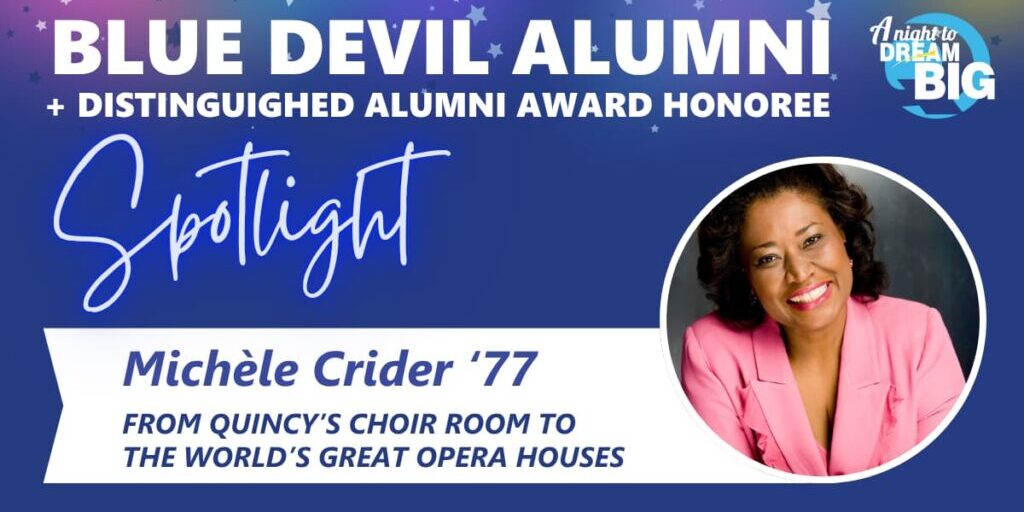
QHS Alumni Spotlight: Michèle Crider ’77
From Quincy’s Choir Room to the World’s Great Opera Houses
By: Katie Rodemich ’02
Sometimes the most extraordinary journeys begin in the most familiar places. For Michèle Crider ’77, that place was Quincy—where a family of singers, a church choir, and dedicated teachers first nurtured her gift. From those early notes, her voice carried beyond her greatest dreams, reaching the great stages of Geneva, Vienna, and Milan.
This November, she returns to Quincy, where it all began, to be honored as a Distinguished Alumna at the A Night to Dream Big Gala, where she will be celebrated for her extraordinary career and lasting contributions to the arts—a true full-circle moment for an artist who has never lost touch with her roots.
Crider’s story begins in Quincy, Illinois, where she was raised as one of ten siblings in a family passionate about music. Music was woven into her daily life—it was both a family language and a form of spiritual expression. By the age of three, she was already stepping forward as a soloist in the Angelic Choir at her church, her young voice offering a glimpse of the incredible talent that would one day captivate audiences across the globe.
Though Michèle Crider’s voice has soared across the world’s great opera houses, she is quick to emphasize that her gift is part of a larger family harmony. Raised in Quincy in a home where music was ever-present, she sees that tradition flourishing in the next generations. With a laugh, she traced the connections: “Anthony Oliver ’92—that’s my nephew. Isabella Green ’22 is my great-niece, and her sister Gabrielle. And yeah, we have a little bit of talent going on there.” Spoken with warmth and pride, her words reveal a simple truth: in the Crider family, creativity is not just an individual achievement—it is a shared legacy that continues to grow.


By the time she arrived at QHS, the school itself was in a distinctive era. Within QHS there were different “schools” under one roof—traditional, flexible, vocational, and specialized programs for music, art, and trades.
“It was the traditional setup for a mid-sized town, but during my junior high years they started dividing the schools differently. Junior high was seventh and eighth grade, then ninth and tenth grades were in a separate building. It was called CI One. The new senior high housed eleventh and twelfth grade, so you weren’t thrown in with the upperclassmen right away. Looking back, I thought it was a really good idea. It gave kids a chance to develop among their own age group. Once I got to the senior high, they also had divisions within the school. There was the traditional school, the flexible school, the vocational programs, and specialized areas for music, art, and trades. Everyone could try out different departments but still follow a main course of study. I was in the flexible school, which was perfect for me—I was focused on the arts, but I also had opportunities to study languages and other subjects. I really liked that setup.”
Crider enrolled in the flexible school, which gave her the chance to focus heavily on the arts while also exploring languages and academic interests. That freedom proved invaluable. It nurtured her curiosity, expanded her skills, and provided her with the creative space she needed to grow into the artist she would become.
When reflecting on the mentors and educators who shaped her path, music stands at the center. Her QHS years were steeped in choir, and her signature mentor was Director Dan Sherman, who served as both guide and inspiration—known for treating students like professionals and drawing out their very best. “Of course, Mr. Sherman—Mr. Sherman is an icon.” Under his leadership, she thrived in Concert Choir, Madrigal Choir, Swing Choir, and the beloved annual tradition of Vespers, which brought music, tradition, and community pride together in one unforgettable performance.
Choir was vibrant with energy and tradition. Beyond the main Concert Choir, students could explore other ensembles. “Beyond the Concert Choir, which was fabulous, we had the Madrigal Choir and the Swing Choir—different genres that kept things fresh and gave us a chance to stretch. I loved it.”
Some traditions endure, as timeless as ever. “Of course, the great Christmas concert—Vespers. I came into choir as a sophomore because of the way the schools were divided, and walking into Vespers for the first time was magic. With the division of the schools, it was normal for students to come over from the other building for lessons, so I got to go over, and that was quite the event.
“As a younger student, just to experience this—it was magic and amazing. The seniors were the ones who walked in, and the juniors were the ones on the stage keeping the beat. It gave me chills then, and it still does. It still takes me right back. You’d think after so many years it might fade, but it never does. It’s like stepping into the Blue Devil gym or the theater—it transports you.”
Other names surfaced with a smile as Crider recalled the people who shaped her beyond the choir room. “My Spanish teacher, Susan Hoff—I still keep in touch with her now and then. Every once in a while, I’ll write and tell her I’m using my Spanish skills. Then there was my wonderful English teacher, Larry Pritchard, and Terry Scherer too. Back in my junior high years, Doris Nelson led the girls’ athletics program—this was before boys and girls could mix classes. She made a real impression on me.”
Beyond her QHS choir training, Crider also gained formative stage experience at what was then Quincy Community Little Theater. As a teenager in the 1970s, she joined productions under the direction of Barbara Rowell, discovering a love for theatrical storytelling that blended acting, movement, and song while building the confidence to carry herself on stage.
After high school, she continued to embrace every opportunity to perform. She joined Barbara Rowell’s troupe on summer excursions to the Golden Eagle Showboat Dinner Theatre, a riverboat stage in nearby Canton, Mo., that Rowell directed in the late 1970s. Night after night, Crider gained invaluable stage experience, expanding her artistry beyond music alone. Those productions taught her timing, movement, and the discipline of connecting with a live audience. Each role reinforced skills she would later carry into opera: commanding the stage, collaborating with fellow performers, and fully inhabiting a character. Under Rowell’s guidance, Crider was pushed to rehearse with professionalism, adapt quickly in challenging situations, and always give her best. That blend of encouragement and rigor laid a foundation that shaped her future career on the world’s great opera stages.
Crider pursued a Bachelor of Music at Culver-Stockton College in Canton, Mo. From there she spent a year in New York City studying voice before enrolling at the University of Iowa, where she earned her Master’s degree in vocal performance. At Iowa she worked under Dr. John Van Cura and Beaumont Glass, and later studied with the legendary Simon Estes, gaining opportunities to perform leading roles in La Traviata, Don Giovanni, and Madama Butterfly.
A pivotal moment came during a masterclass with internationally acclaimed soprano Gloria Davy, who encouraged her to audition for European programs. That advice led to her acceptance into the Zurich Opera program.
“I had taken a master class with the renowned soprano Gloria Davy, and she asked me what I was planning to do next. I told her I was finishing my studies, and she said, ‘You should be doing something more.’ Taking her advice seriously, I auditioned for the opera program. I had the opportunity to sing a concert with Simon in Des Moines, Iowa, and afterward we talked. He suggested that I go to Europe. Then, I applied for an audition with the Zürich Opera program. They accepted me, and I spent a year there. After many auditions, I went on to win the Geneva International Music Competition. That really started my career, because the final concert was broadcast across Europe on Eurovision. Many people heard me through that broadcast—that’s how it all began.”
Michèle Crider’s leap of faith paid off spectacularly. Soon after, she captured international attention by winning the Geneva International Music Competition in 1989—another victory broadcast across Europe on Eurovision. Preparing for Geneva pushed her into new repertoire—the competition required her to perform Leonora from Verdi’s Il Trovatore, a role she learned in just three weeks for an opera staging in Dortmund, Germany. To her surprise, Crider discovered that the passionate Verdian style suited her voice perfectly.
Winning the Geneva competition proved to be Crider’s ticket to the international opera world. Virtually overnight, European opera companies that had previously been uninterested were clamoring to engage her. In quick succession, she also won the International Grand Prix competition in 1990, after having been a finalist in Luciano Pavarotti’s vocal competition in 1988. These accolades heralded the arrival of a significant new talent and launched her international career.
Her defining breakthrough came not long after, in a scene as dramatic as any opera. In the early 1990s, while singing as a resident soloist at the Stadt Theater St. Gallen in Switzerland, Crider received an urgent call from the Vienna State Opera: their soprano for Un ballo in maschera had fallen ill—could she step in as Amelia that very night? She had sung the role just the evening before in St. Gallen, and without hesitation she accepted. What followed was a mad dash worthy of the stage itself: a missed flight, a delayed connection, and finally a police escort racing her from the airport to the opera house. She arrived minutes before curtain, thrown into a too-big costume and too-small shoes, and still delivered a performance so compelling it saved the production. The Viennese audience roared their approval, and the company promptly engaged her for the following season.
From that moment, Crider’s star rose swiftly. Beginning in 1991, she made debuts at the Vienna State Opera, Berlin State Opera, Bavarian State Opera in Munich, Hamburg State Opera, and the Deutsche Oper Berlin. In 1992, she appeared at Italy’s Arena di Verona Festival, followed soon after by Teatro alla Scala in Milan, where she sang in Boito’s Mefistofele. By the mid-1990s, her Vienna rescue had become a career-defining story, and in 1994, fellow alumnus Ethan Prater ’91 met her backstage at the Vienna State Opera, stunned to find a fellow Quincy Blue Devil at the pinnacle of European opera.
Her American breakthrough came in 1996, when she made her U.S. operatic debut in the title role of Verdi’s Aida with San Diego Opera. Critics and audiences alike hailed the Illinois soprano’s arrival back on home soil. Soon afterward, she was engaged by other leading American houses—making her Metropolitan Opera debut in New York as Madama Butterfly (Cio-Cio-San) and appearing at San Francisco Opera again as Aida in the late 1990s.
Crider became especially celebrated for her portrayals of Verdi heroines—Aida, Leonora, Elisabetta, and Amelia among them. Critics praised her ability to marry vocal power with emotional depth, and Aida in particular, became one of her signature roles, performed in leading houses around the globe.
Her artistry also extended far beyond opera stages. Crider appeared with the Vienna Philharmonic, Berlin Philharmonic, London Symphony Orchestra, and countless others in works ranging from Beethoven’s Ninth Symphony to Verdi’s Requiem. Her career brought admiration not only for her voice but for her grace, humanity, and the pride she carried in her Quincy roots.
In 2010, Crider returned to Quincy as a guest artist with Muddy River Opera, taking on the title role in Madama Butterfly. For local audiences, it was a rare chance to see a hometown talent who had graced the world’s great stages back in the very community where her journey began.
“I had the opportunity to come back and perform Madama Butterfly,” she recalled. “Coming from the stage, you drew everybody with you, and everyone had to rise to the occasion. Everyone gave their hearts. It was a very crunch-time production, but it came together beautifully.”
The performance became more than just a homecoming; it was a reminder of Crider’s ability to inspire excellence in those around her. Even under pressure, she brought out the best in her colleagues, leaving Quincy audiences with a memory of artistry, resilience, and pride that still lingers.
Alongside her celebrated performance career, Crider has remained deeply committed to teaching and mentorship. Since 2012, she has served on the faculty at the prestigious Mozarteum University in Salzburg, Austria, where she has guided and inspired singers from around the world. Many of her students have gone on to professional careers, carrying her influence onto stages across Europe and beyond.
Teaching, she notes, has been as rewarding as performance itself. Over the years, she has mentored singers of extraordinary talent, with many moving on to become professionals. “I’ve been very lucky—it’s been a gift to have such talented singers pass through my studio.” As she approaches retirement from the Mozarteum in spring 2026, she is already planning her next chapter: opening her own performance studio!
With her return to Quincy to be celebrated, Crider reflects on the foundation she built in Quincy and shares the wisdom she hopes will guide and encourage the next generation of artists. For her, it all begins with the basics.
“If you’re a singer, learn your languages, and certainly learn your music theory. It’s important. If you’re going to be in this, you’ll never leave those fundamentals behind. Even if you never sing in anything but English, you still need to understand rhythm and style. And don’t be afraid. Don’t be afraid. Go out, try it. You can’t know it if you don’t do it. And I think—work hard. Because when you work hard, of course, when you succeed, you appreciate it that much more. That’s what I tell my own girls—I have two of them. Also: be patient. Be patient.”
Gratitude is just as present in her reflections as advice. Crider credits not only her family and teachers but also the community that stood beside her from the very beginning.
“I just want to thank all my family, friends, and the people who had so much input in the development of my studies. The community really supported me from the start—you could go from Jack’s Discount to the banks—people all along the way helped me in so many different parts of my career. I’m very appreciative, and I haven’t forgotten anyone. Hopefully I’ll get to see some of them and I’m looking forward to my time back home.
This November, she will see many of those faces again when she is honored at A Night to Dream Big. For Quincy, it will be a chance to celebrate one of our own. For Crider, it will be another reminder that no matter how far her voice has carried, it always carries echoes of home. Her success is a testament to the values instilled in her by her family and the Quincy community. Through all of her accomplishments she has remained deeply connected to her roots. On November 7, 2025, she will be honored as the Distinguished Alumni at the A Night to Dream Big Gala, hosted by the Quincy Public Schools Foundation—a recognition of her extraordinary career and contributions to the arts, and a full-circle moment for an artist who has never forgotten where she came from. It is clear that the Quincy community is proud of her, and grateful for the gift she has shared with the world.
Nominate a Blue Devil
We want to hear from you! Nominate a fellow Blue Devil you want featured in our upcoming newsletter.
QHS Alumni Spotlights
Catch up on the latest with more QHS Alumni Spotlights.